
XSIS222A
for Manned Aircraft
Advanced Situational Awareness for Helicopters on Critical Missions
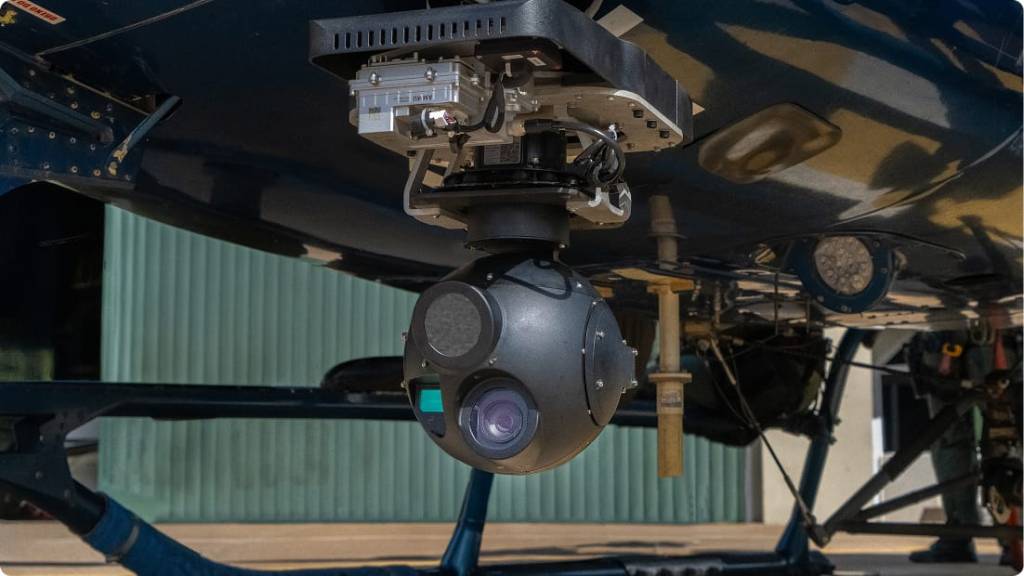
The XSIS 222A is a domestically developed EO/IR sensor designed to enhance situational awareness for helicopters during public safety operations, patrols, search and rescue missions, and tactical monitoring.
With a highly competitive value proposition, the solution combines a lower acquisition cost, domestic technical support, rapid integration into aircraft, and high operational availability to meet the demands of mission-critical operations.
- Daytime and nighttime operation
- Competitive investment
- National Technical Support
- Higher operational availability

Air operations require more than just visibility
The XSIS 222A combines EO (optical) sensors, MWIR (mid-wave infrared), LRF (laser rangefinder), and LP (laser pointer) sensors in a Low-SWaP architecture, designed for simplified integration into helicopters deployed on intelligence, reconnaissance, surveillance, patrol, and search and rescue (ISR-SAR) missions.
Compact, lightweight, and easy to install, the system delivers high-quality images for both daytime and nighttime operations and enhances the ability to monitor, track, and support decision-making during the mission.
Its modular architecture facilitates integration between different aircraft platforms and reduces aircraft downtime, providing greater operational flexibility and increased agility for field crews.
A compact, rugged, and ready-to-use ISR-SAR solution
The XSIS 222A is a high-performance solution that delivers advanced tactical intelligence in a compact (Low-SWaP) format. It integrates precision sensors — EO (optical/standard camera), IR (infrared/thermal), LRF (laser rangefinder), and LP (infrared laser pointer) — it transforms any helicopter into a robust platform for intelligence, reconnaissance, surveillance, and search and rescue (ISR-SAR).
Compact, lightweight, and easy to install, the system delivers high-quality images for day and night missions, ensuring enhanced real-time monitoring, tracking, and operational support capabilities.
Thanks to its versatile architecture, the system can be easily transferred between aircraft, which reduces downtime and dramatically increases the readiness of field crews.
Operational Capabilities

Greater efficiency in critical aviation operations
From urban monitoring to smart tracking and operations in remote areas, the XSIS 222A expands the capabilities of field teams.
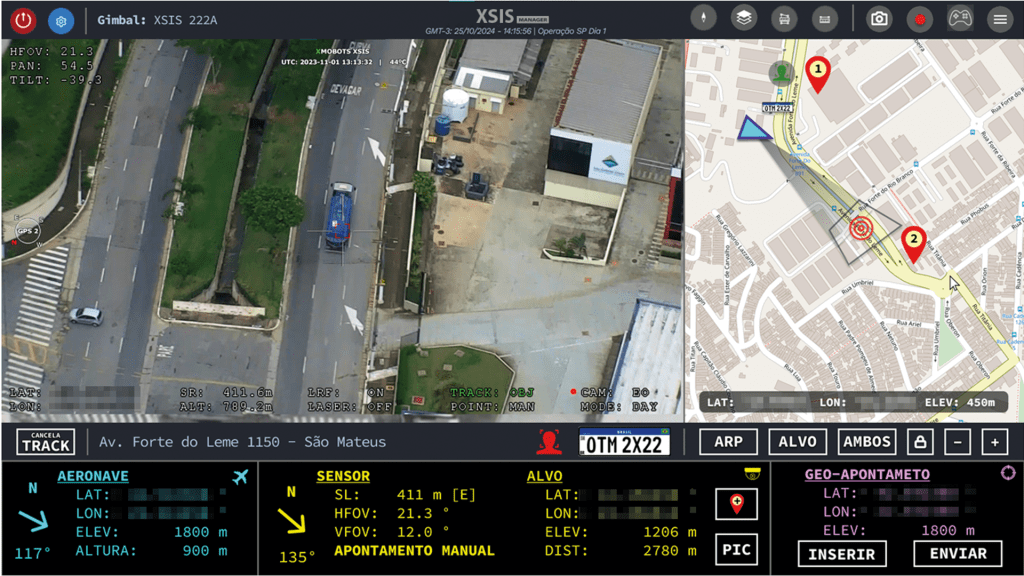
Software allows users to search for targets by coordinates and addresses
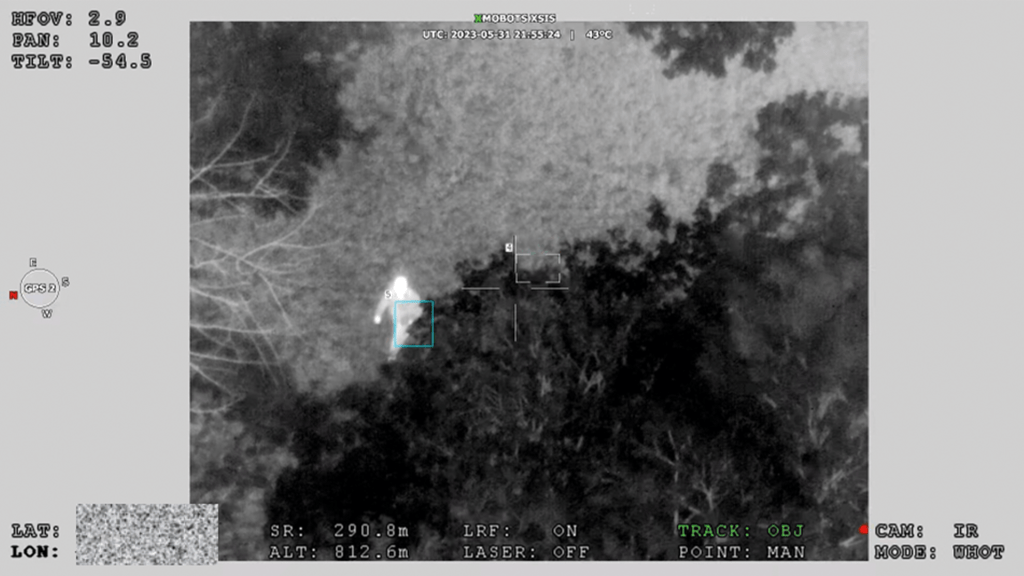
Night Surveillance with MWIR Sensor

Picture in picture
Plate reading
Image captured at 14 km
Designed for maximum stability and performance
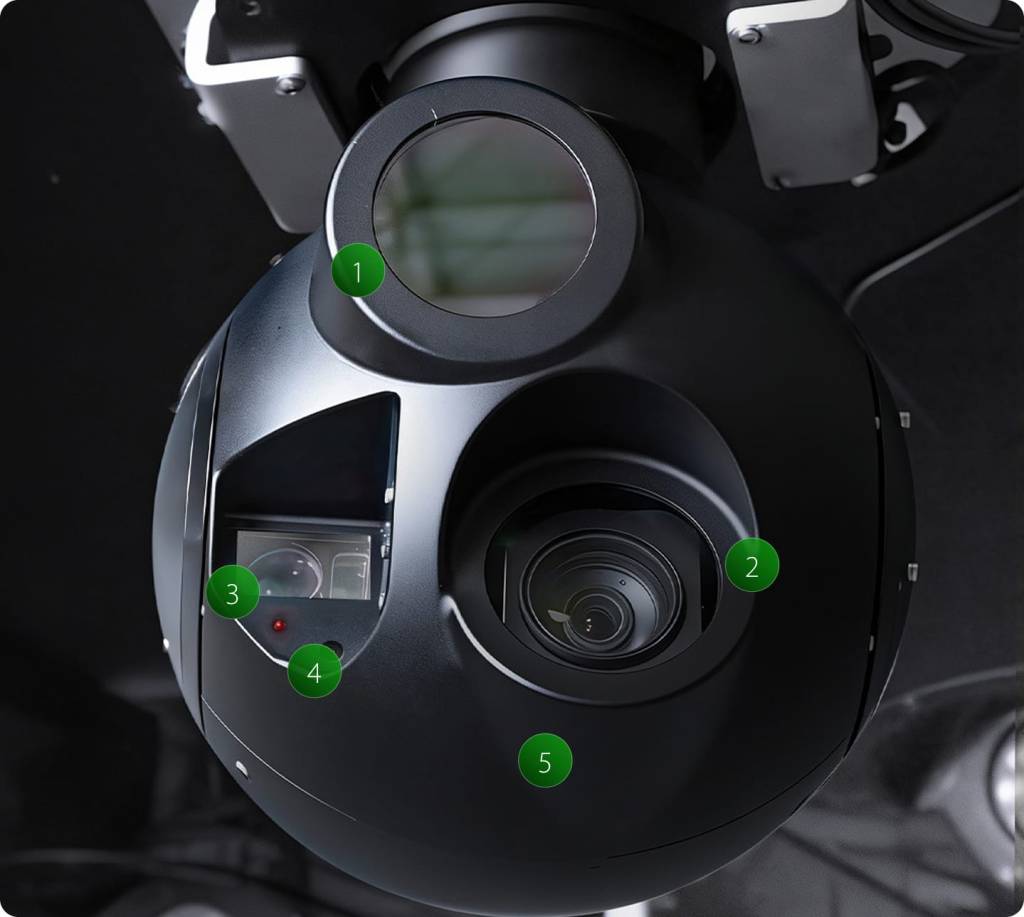
1
SD MWIR Camera with 14x Optical Zoom
2
Full HD EO Camera with 30x Optical Zoom
3
Rangefinder
4
Laser Pointer
5
Weatherproof
MTI: Moving Target Indicator
Tracking of stationary and moving targets (people, cars, boats, etc.)
Target acquisition: Determination of the geographic coordinates of the target
Locking: Scene-Based Image Tracking
Note/ Geofencing: based on coordinates and points of interest (POIs) defined by the operator.
3-axis gimbal: No gimbal lock effect at the nadir
Automatic horizon leveling, eliminating the image tilt (roll) present in 2-axis systems.
Direct Drive: Ultra-precision direct-drive motors with a proprietary FOC control algorithm.
Digital Stabilization: EIS - Digital Video Stabilization
Low Maintenance: Long-life BLDC motors
Weight: Less than 6 kg
Profile: 22 cm/9”
Export: NON-ITAR
STANAG 4609 Compliance: Full MISB KLV Telemetry: KLV Available
Removable encrypted SD card to prevent data leaks in the event of system loss.
MIL-STD 810H Compliance: The system uses aviation-grade alloys and components in a fully sealed design.
High-quality, long-range images to support crime-fighting efforts.
Reliable search and tracking of stationary or moving vehicles
Stable search and tracking of suspects in groups
Continuous monitoring, day and night, of large-scale events, active operations, and high-risk areas, including forested and remote regions.
Integration with a database that automatically retrieves information—based on the license plate—about reported incidents, fines, the owner’s name, vehicle registration renewal, and other details.
Identifying people's characteristics (clothes, accessories and colors)
Fire Source Detection and Monitoring
Image Resolution for License Plate Recognition (Additional License)
Image resolution for facial recognition (additional license)
More information, more control, and faster decisions
In critical operations, having access to the right information at the right time makes all the difference.
For this reason, the XSIS 222A features the GCS112A control station and the XSIS Manager software—a combination designed to provide the operator with a complete overview of the mission in progress.
From a single interface, the operator has access to the key features for monitoring and decision-making:
- Real-time images of the operation;
- Mobile map showing the aircraft's position;
- Operational data integrated into the mission;
- Tracking of observed targets;
- Intuitive, easy-to-use interface; License plate recognition powered by artificial intelligence.
Johnson's criterion (DRI) Daytime EO
Detection
Recognition
Identification
Human

Detection
15 km² – 30 km²
(There's something there)
Recognition
4 km² – 8 km²
(There's something there that looks like a person)

Identification
2 km² – 8 km²
(There's someone over there.)
Vehicles

Detection
30 kmᶜ
(36kmᵃ – 72 kmᵈᵇ)
(There's something there)

Recognition
9 km² – 18 km²
(Something that looks like a vehicle is there)
Identification
5 km² – 9 km²
(There's a vehicle over there.)
Vessels

Detection
30 kmᶜ (122 kmᵃ – 245 kmᵈᵇ)
(There's something there)
Recognition
30 kmᶜ (30 kmᵃ – 62 kmᵈᵇ)
(There's something that looks like a boat over there)
Identification
15 km² – 30 km²
(There's a boat over there.)
Johnson's criterion (DRI) MWIR Night
Detection
Recognition
Identification
Human
Detection
6 km² – 11 km²
(There's something there)
Recognition
2 km² – 3 km²
(There's something there that looks like a person)
Identification
1 km² – 2 km²
(There's someone over there.)
Vehicles
Detection
14 km² – 28 km²
(There's something there)
Recognition
4 km² – 7 km²
(Something that looks like a vehicle is there)
Identification
2 km² – 4 km²
(There's a vehicle over there.)
Vessels
Detection
30 kmᶜ (47 kmᵃ – 96 kmᵈᵇ)
(There's something there)
Recognition
12 km² – 23 km²
(There's something that looks like a boat over there)
Identification
6 km² – 11 km²
(There's a boat over there.)
a- Detection probability: 90%
b- Detection probability: 50%
c- Practical value, considering normal conditions of humidity, pollution, etc.
d- Theoretical value, considering a thermal constant of 2 degrees Celsius, atmospheric attenuation factor
0.2 km-1, visual contrast 20%, illumination 1000 lux.
Recognition
Sign Reading
Recognition
300 m
Recognition
Facial
Recognition
300 m
Specifications
EO sensor
HFOV: 63.7° - 2.3°. 1080p
Resolution and FPS: 1920x1080 @ 30 fps
Zoom: 30x optical / 360x combined digital
Sensor type: 1/2.8 inch - Exmor R CMOS
MWIR sensor
Spectral range: 3 - 5 μm
HFOV: 28.4º - 2º
Resolution and FPS: 640 x 512 @ 30 FPS
Zoom: 14x optical
Sensor type: IDC InSb cooled
Others
LRF: Up to 5 km (2.6 km NATO standard)
IR Pointer: OVN-compatible beam, 850 nm, 250 mW with 0.4 mrad
Domestic technology with local support for ongoing missions
In addition to its high operational capacity, the XSIS 222A offers key strategic advantages for critical operations.
As a national solution developed by Xmobots, the system offers shorter maintenance lead times, specialized support, and faster technical and operational service.
This means greater aircraft availability and higher reliability for missions that cannot be interrupted, including the availability of a backup sensor.
The close relationship between the manufacturer and the operator also allows for greater efficiency in training, software updates, specialized technical support, and the development of new features as operations evolve.
More availability for those who can't stop
Learn about the XSIS 222A and discover how to expand the operational capabilities of your manned aircraft with onboard intelligence, high stability, and specialized support.