
VTOL system guarantees versatility, autonomy and efficiency, without the need for a runway
The introduction of VTOL(Vertical Take-Off and Landing) technology has significantly expanded the operational capabilities of drones.
This innovation allows aircraft to take off and land vertically, eliminating the need for runways and opening the door to operations in hard-to-reach or hostile locations.
As a result, VTOL drones are redefining standards in sectors such as defense, security, agriculture and environmental monitoring.

In addition to this expansion, VTOL also offers other advantages over traditional drones, such as versatility, autonomy and operations in challenging environments.
Versatility in challenging terrain
One of the main benefits of VTOL technology is the ability to operate in restricted spaces or uneven terrain.
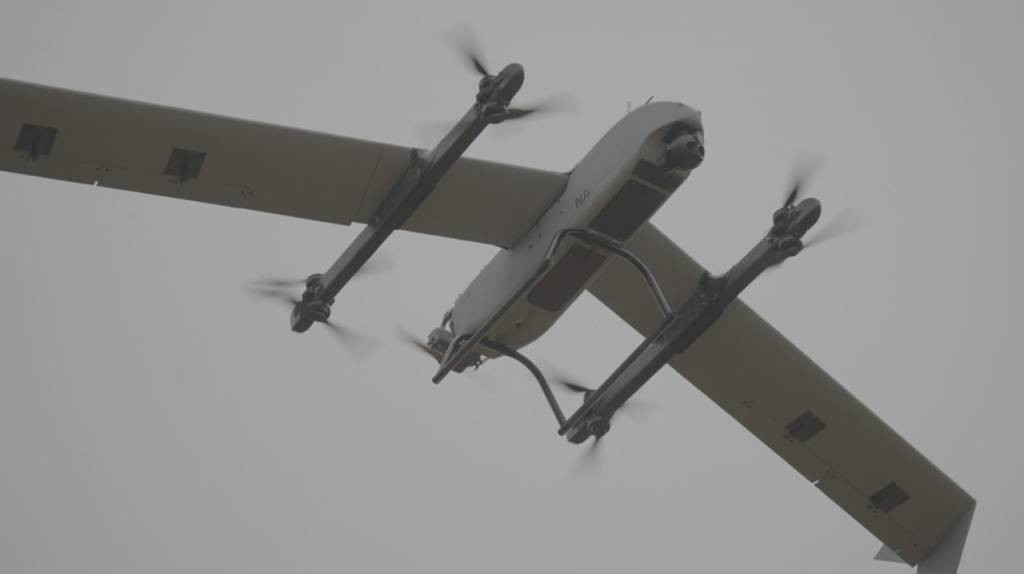
Drones equipped with this technology combine the horizontal flight efficiency of fixed wings with the vertical take-off and landing flexibility similar to helicopters.
This duality allows them to be used in dense urban environments, forests, mountainous areas and even in natural disaster scenarios where infrastructure is limited or non-existent.
Expanded autonomy for strategic missions
Optimized for longer missions, VTOL drones fly longer and more efficiently. This is possible because this technology allows fixed-wing drones, for example, to save energy (battery and fuel) and cover large areas.
This is a huge advantage, especially in mapping operations (agriculture, geology, construction and forestry) and monitoring (forest fires, private property, public institutions and events).
Operations in challenging environments
The agility and precision of VTOL drones make them ideal for emergencies. In cases of natural disasters such as floods, landslides or earthquakes, they can be quickly deployed to search for survivors, map affected areas and provide real-time data to rescue teams.
They are also used by the armed forces, police and environmental agencies for patrols, inspections and surveillance.
The origin of VTOL
Vertical Take-Off and Landing began to be developed at the beginning of the 20th century, driven by the need to access hard-to-reach regions without relying on airport infrastructure.
With advances in electronics, control systems and engines, VTOL has been improved and adapted for various applications, including drones.
The future of smart cities
The integration of VTOL drones into urban mobility systems promises to revolutionize the functioning of smart cities.
"VTOL is still developing and is now being used more in emerging areas, such as infrastructure. Bridges, roads and high-energy towers require monitoring over large areas"says João Paulo Eguea, a professor in the Aeronautical Engineering Department at the São Carlos School of Engineering (EESC-USP).
As well as monitoring critical infrastructure such as bridges, roads and power grids, these drones can be used to transport medicines, food and parcels, once the necessary regulations are in place.
"If we think about big cities like São Paulo, which has an airport within the city, it's necessary to integrate drone operations into the air network, taking into account commercial and private aircraft, helicopters, as well as other obstacles. It's important for academia, industry and certification bodies to work together", emphasizes Eguea.
Nauru 500C ISR: the VTOL with ANAC certification
Developed by Xmobots, the Nauru 500C ISR is a VTOL drone that combines fixed wing and multirotor, offering versatility and high efficiency. It is the only drone in its category certified by the National Civil Aviation Agency (ANAC) for day and night operations.
With a flight autonomy of four hours and a communication range of up to 60 km, the Nauru 500C ISR is ideal for intelligence, surveillance and reconnaissance missions.
- Read more: meet the Nauru 500C ISR from Xmobots
"In addition to VTOL, the technologies embedded in the Nauru series allow for great monitoring capacity both in the visible spectrum and with heat maps using infrared, measuring the distance and coordinate of a location," explains Xmobots' Service and IDP Specialist, Anderson Vito.

"The Nauru 500C ISR is agile in operation. The VTOL allows it to be assembled in record time, making it more effective in action and enabling missions in all environments. It's a professional drone with high performance. All the investment and study into the Nauru keeps Xmobots at the forefront," says Vito.says Vito.
Nauru 1000C: the Brazilian Army's VTOL system
The Brazilian Army acquired the Nauru 1000C VTOL system from Xmobots, through an official tender, for homeland defense missions, such as border monitoring.

The Nauru 1000C system has three remotely piloted aircraft and a ground control station with state-of-the-art onboard technology.
Recently, the Nauru 1000C took part in its first official mission during Operation Perseus - the biggest military training event of the year, simulating scenarios close to the reality of combat.
Nauru 100D: an invisible ally
Launched this year by Xmobots, the Nauru 100D is a tactical drone designed to serve military forces in critical operations. The new model combines practicality and performance to strengthen border surveillance, the fight against organized crime and threat interception.

Built with anti-reflective materials, the Nauru 100D has a low thermal, sound and visual signature, making it virtually undetectable. The eVTOL(Electric Vertical Take-Off and Landing ) technology enables silent infiltrations for inspections, surveillance and attacks.
Conclusion
VTOL technology is transforming how drones are used, offering innovative solutions to complex challenges.
Whether for defense missions, environmental monitoring or emergency response, VTOL drones are proving to be indispensable tools for the future of security and operational efficiency.