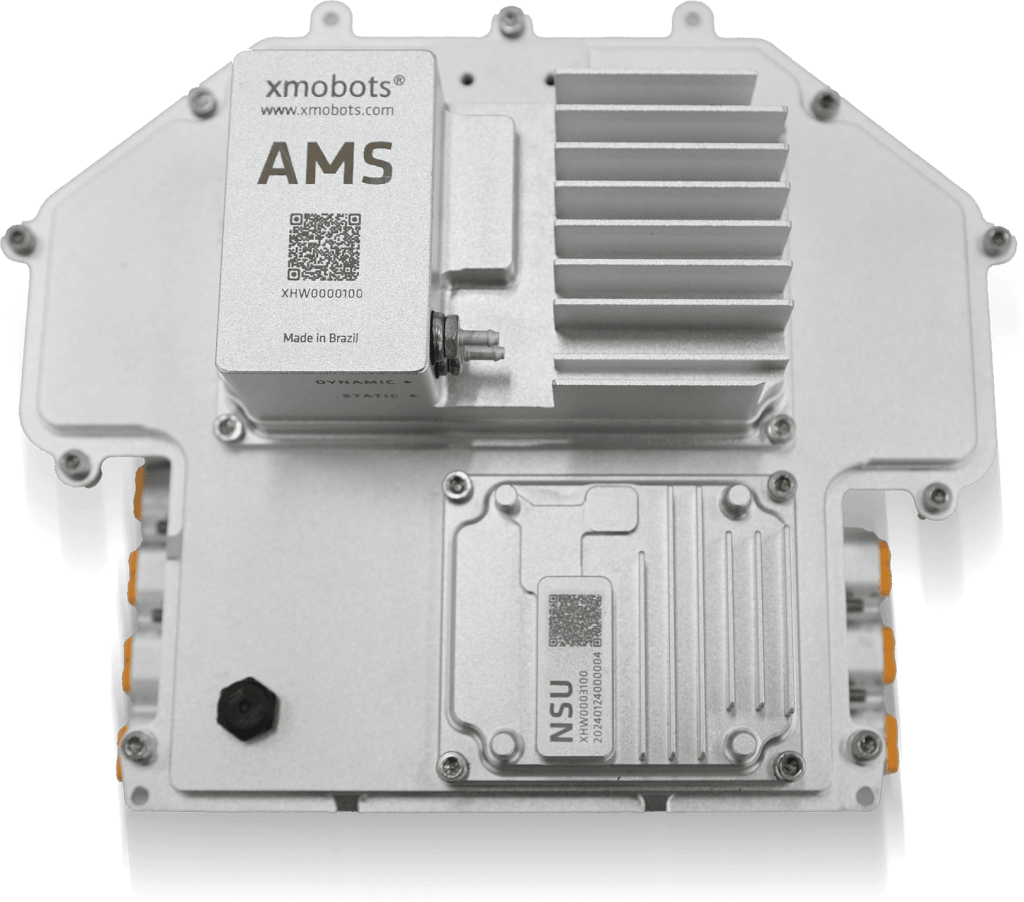
AMS7G
7th Generation Avionics System of the FW7 Platform
Nauru 100D's core technology for more stable, safe, and intelligent flights.
Modern architecture for maximum reliability
The AMS7G (Automatic Management System – 7th Generation) is the avionics brain of the Nauru 100D, coordinating all essential flight subsystems. Its architecture utilizes modular hardware, deterministic multicore processing, and electrically isolated interfaces, ensuring stable performance even in harsh environments.

Accurate and redundant hybrid navigation
The system combines redundant GNSS, nine-axis IMU, and high-precision auxiliary sensors. The magnetometer is installed in an isolated area of the fuselage, reducing interference from engines, power buses, and metal structures.
This combination ensures stable navigation even under strong vibration or poor signal quality.
Accurate and redundant hybrid navigation
The system combines redundant GNSS, nine-axis IMU, and high-precision auxiliary sensors. The magnetometer is installed in an isolated area of the fuselage, reducing interference from engines, power buses, and metal structures.
This combination ensures stable navigation even under strong vibration or poor signal quality.
Advanced and intelligent EVTOL control
The AMS7G features flight software with tuned control algorithms to ensure aircraft stability during VTOL takeoff and landing phases.
In addition, it has guidance algorithms that manage the transition between different flight regimes. The navigation system monitors the aircraft's position and attitude in real time and tracks the health of the subsystems through signals such as current, voltage, temperature, and rotor RPM, with the aim of identifying possible failures and triggering contingency protocols.
Complete energy and autonomy management
The module monitors voltage, current, temperature, and residual battery capacity.
It integrates with the PDBU (Power Distribution and Battery Unit), which is responsible for distributing power and acting against hazardous conditions such as overcurrent, undervoltage, or thermal imbalances.
Full electrical protection and shielding against interference
The electrical architecture has been designed for maximum robustness, with:
Galvanic isolation
EMI/EMC Filters
Surge and ESD protection
Metal shielding
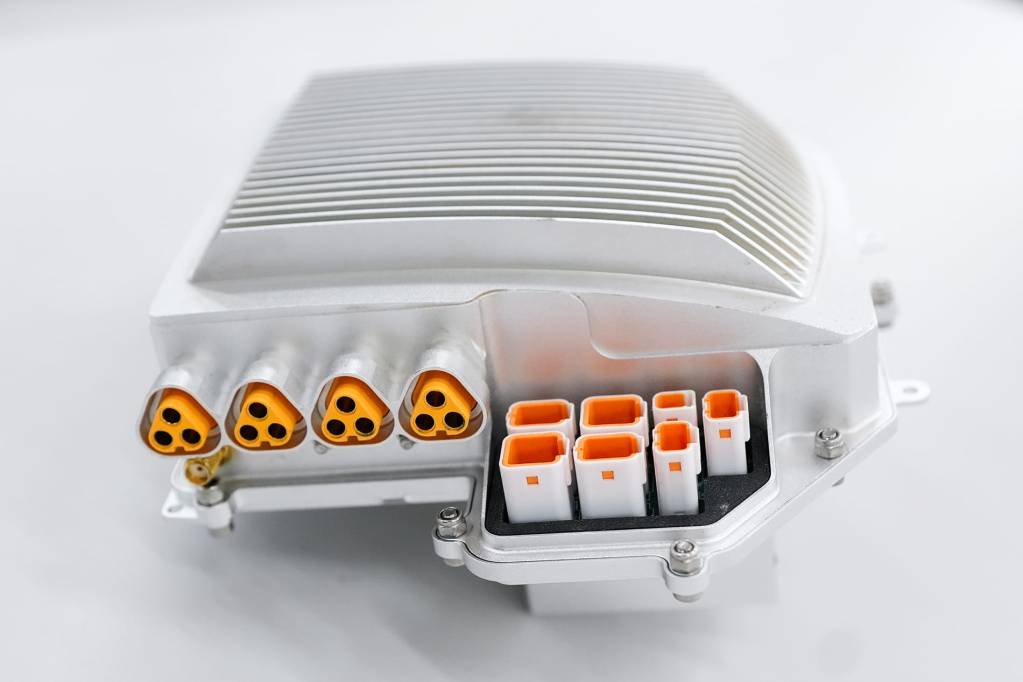
IP65 sealed enclosures
Power, signal, and communication buses are segregated to avoid coupling and prevent fault propagation—essential for flights in high electrical noise scenarios.
Modular, easy-to-maintain peripheral modules
The modules are connected to the AMS7G in a star topology, point-to-point. This approach facilitates maintenance, field replacements, and fault diagnosis, with each module featuring its own EMC protection and sealed connectors.
Continuous monitoring and advanced telemetry
The AMS7G performs internal diagnostics without interruption, monitoring:
Temperature
Voltage and current
Status of critical algorithms
This data is sent via telemetry for remote analysis, enabling fault prediction, functional integrity validation, and keeping all subsystems within safe limits.
State-of-the-art avionics for safe and reliable operation
The technical version of the AMS7G brings together the latest advances in hybrid navigation, EVTOL control, power management, and continuous supervision, always with a strong emphasis on electrical isolation and interference mitigation.
It is the foundation of the Nauru 100D's operational reliability—ready for mission-critical tasks and challenging environments.