
Most people have heard that airplanes are one of the safest means of transportation in the world. However, few are aware of what really lies behind this characteristic of air vehicles.
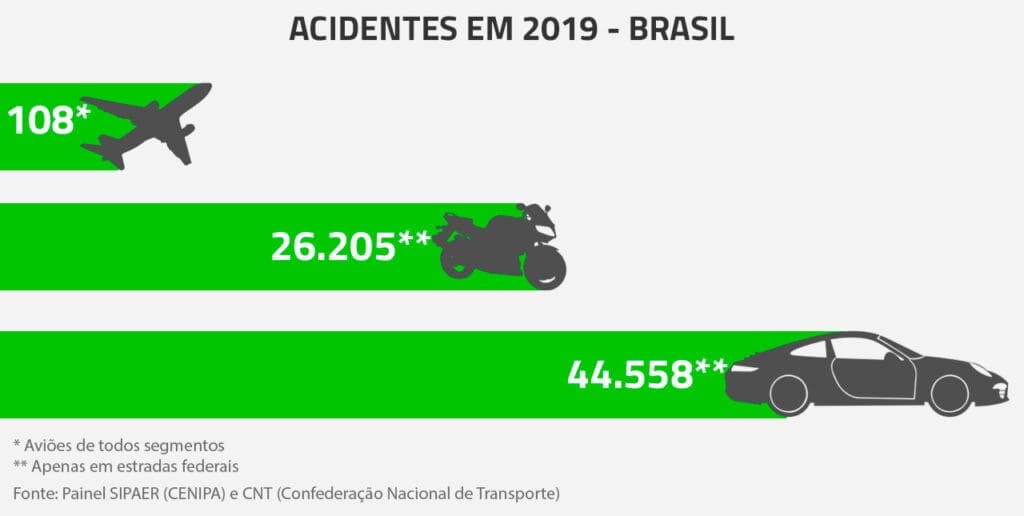
The high level of safety provided by air transportation is actually the result of tens of thousands of hours of engineering. These are studies, investigations, categorizations and analyses of the most diverse possible causes of accidents (and sources of failure in general), which have led to the development and dissemination of various means of avoiding these catastrophes, called "risk mitigation means". The fruits of these processes can be seen when, for example, we compare the rates of fatal accidents (per number of kilometers traveled) caused by the most common everyday vehicles (cars and motorcycles) with those caused by accidents involving air passenger transport vehicles. While the rates are dozens of times higher for cars than for air vehicles, the situation is even more serious for motorcycles: the difference between the fatality rates per km traveled is in the hundreds.
The guarantee that a system has been developed in accordance with these mitigation measures, in turn, is provided by the issuing of certificates(e.g. airworthiness and approval certificates) and authorizations by national regulatory authorities to the bodies responsible for disseminating and demanding compliance with safety standards. In other words, it is through these certificates that the technical and operational capacity of both systems and operations is guaranteed. In the case of Brazil, the regulatory agencies involved in civil aviation are mainly the National Civil Aviation Agency (ANAC), the Department of Airspace Control (DECEA) and the National Telecommunications Agency (ANATEL).

Obtaining these "safety level" certificates and authorizations, however, is no simple task. Even before the system design is drawn up, the regulatory bodies provide an extensive list of requirements to be met by the manufacturer. In the context of system certification, these are known as requirements and means of compliance. Simply put, the requirements define the standard (safety level) to be achieved by the systems, taking into account their capabilities, complexities and operational contexts; and the means of compliance determine how to prove that this standard has been achieved through tests, analyses, technical reviews, etc.
These requirements and means of compliance, although established by national authorities, are based on international standards, which in turn are decided at conventions held by experts from various countries, always with a view to maintaining the level of safety in the aviation sector, without jeopardizing the performance and functionality of its systems.
After examining the list, the manufacturer goes on to design the system with a view to meeting the requirements set out therein. Finally, tests (laboratory, ground and in-flight), analyses and all other agreed and appropriate means of compliance for the system are carried out. In general, and for comparative purposes, the design of a certifiable air system (commercial aviation) is designed so that no catastrophic failure (where there is a loss of the aircraft and/or fatalities) occurs more than once every 1,000,000,000 flight hours. This results in an overall safety level of around one fatal accident for every one million flights - the same order of magnitude as the chance of being struck by lightning!

In the context ofRemotely Piloted Aircraft Systems (RPAS), the situation is slightly different. Although they are also considered air systems and, as such, are regulated by the same bodies that govern aviation in general, the variety of RPAS systems and operations has led to the emergence of a new means of mitigating risks and, therefore, guaranteeing safety levels. For systems aimed at relatively simpler operations, instead of requiring certification of the systems (countless tests, analyses, etc.), the authorities impose strong restrictions on the operating environment, such as flights only in small areas, in places where no manned aircraft operate and always within the pilot's field of vision. This type of operation must take place in the RPA operator's line of sight, which is why it is called VLOS (Visual Line of Sight) Operation, and 99% of the drones operating in Brazil are only allowed to operate in this condition.
Although suitable for recreational activities and simple commercial operations, such as building inspections, these operational limitations have a major impact on more elaborate operations or those that require a larger coverage area - e.g. industrial inspections, surveillance operations, and agricultural operations. In addition, RPAs flying in this condition have no guarantee of the quality of their subsystems from aviation regulators, and the only guarantee is that offered by the manufacturer itself. In other words, safety against failures that could cause equipment loss or even put operators and people not involved in the operation at risk is not certified to aviation standards, considering the categories of each system.
On the other hand, those remote systems that are developed to operate in conditions beyond the initial constraints, whatever they may be, are subject to a process very similar to that described above for manned aircraft. This is the case with the RPAs developed by XMobots. Our systems, in addition to targeting the end customer experience, are designed to meet the requirements set by the authorities, guaranteeing our products and our operations safety levels analogous to those of manned aviation.

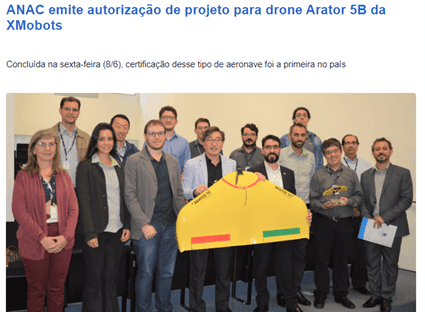
All our aircraft, in addition to being properly equipped with the highest quality and safest components, undergo dozens of tests and careful design analyses before they reach our customers. We were the first company to obtain an Experimental Flight Authorization Certificate for RPAS from ANAC, obtained for the Nauru 500A in 2013, as well as the first to obtain design authorization from the Agency in 2018 for the Arator 5B.
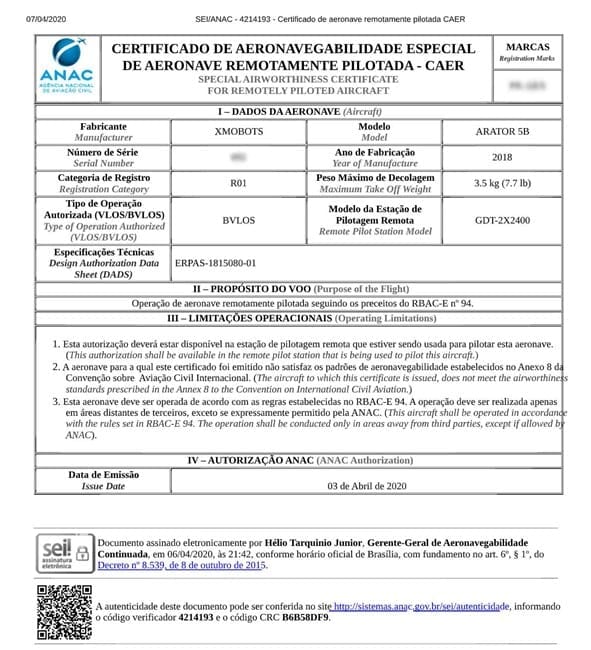
In all, more than 9,600 engineering hours were spent on the design and certification of the Arator 5B RPAS. This aircraft is the only one authorized to fly above the height limit established for simpler operations (around 120 meters) in Brazil, and it is also the only 100% nationally developed system with a project authorized by ANAC, making it one of the few unmanned vehicles in the world to have a project authorized by a certifying agency. The Arator 5B authorization process was so remarkable for its pioneering spirit and the high level of commitment and innovation on the part of the manufacturer, that its project was presented by ANAC as a model for the certification process of this type of system at a meeting of the Certification Management Team (CMT), an international coordination group between four of the most important regulatory authorities in the world. In addition to ANAC, the North American FAA, the European EASA and the Canadian TCCA are members of the group.

And that's just the beginning! With recent developments, both in terms of XMobots' new technologies and the evolution of RPAS regulations, and with the company's efforts to develop equipment with high safety standards, we will soon have more ANAC-certified projects, with ever greater capacities, capable of meeting our customers' demands as efficiently as possible.

To find out more about the RPAS developed and manufactured by XMobots, visit our website: www.xmobots.com.br or contact us: contato@xmobots.com.br.
Matheus Coelho Gonçalves, Certification Analyst at XMobots