
With recent technological advances and the popularization of drone mapping technology, a tool that was previously only seen in scientific research on experimental farms has been gaining more and more ground in day-to-day applications in various industries: multispectral cameras.
The main feature of a multispectral camera is its ability to capture images not only in the visible spectrum (Red, Green and Blue bands - RGB), but also in the non-visible spectrum, such as the Red Edge andNear Infra-Red ( NIR).
With this technology, it is possible to differentiate, for example, between a healthy plant and one under water stress or in senescence, or even to identify an area infested with weeds with great assertiveness.
There are numerous multispectral cameras on the market, each with its own configuration of spectral bands. You can find cameras that capture dozens of spectral bands. There are also differences in terms of the technology used to build the equipment, basically two types: cameras that have a sensor and lens for each spectral band (conventional multispectral cameras), and cameras that use a single sensor to capture all the bands simultaneously.
The main advantage of multi-sensor cameras is their spectral accuracy, as each sensor captures a single band, so the sensor is not exposed to noise or interference from other wavelengths. On the other hand, in order to accommodate several sensors in a limited physical space, they need to be smaller than the sensors used in RGB cameras, which imposes limitations on image resolution and consequently lower mapping performance. In addition, they are very expensive devices.
The other group comprises a wide variety of lower-cost devices that have appeared on the market, popularly known as "modified cameras" or "converted cameras". They are called this because most of them are built by modifying conventional RGB cameras. The process basically involves changing the camera's internal filter (which originally blocks non-visible radiation), replacing it with a filter that allows only the desired bands to pass through.


As the sensors in RGB cameras are originally designed to capture several bands simultaneously and in a different spectral range to the one selected by the filter, this procedure results in numerous problems and optical aberrations. The main problem is the mixing of the different wavelengths in each band of the image, which is called "spectral contamination". Without proper separation of the spectrum in each band, there is a lot of noise in the reflectance data captured, making it impossible to use vegetative indices to analyze crops, since they are based on the proportion of reflectance between the bands.
In addition, modification processes carried out by hand, with low-quality filters and the absence of radiometric calibration make the results even worse. For these reasons, there is a consensus that modified cameras are not suitable for multispectral mapping.
XMobots multispectral cameras breaking the paradigm
With the aim of combining the best of both concepts, XMobots has developed the XMX range of cameras. It consists of a set of hardware and software, resulting in cameras capable of delivering the same spectral accuracy found in multi-sensor multispectral cameras with the higher resolution found in single-sensor converted cameras.
The success of the XMX line is based on sensors with extremely high manufacturing quality and guaranteed spectral band accuracy, the same technology used by the space industry. Allied to the hardware is the image calibration software, which converts the raw data (RAW) from the XMX camera into 16-bit TIFF images with a single band each. In the calibration process, the spectral correction parameters of the bands are applied, as well as correction for the optical aberrations inherent in the sensor/lens set used, resulting in a high-quality multispectral set that combines the radiometric accuracy of multi-sensor cameras with the productivity of single-sensor cameras.
The result can be seen in the figure below, which shows the comparison between the images and NDVI index from the XM5 camera versus a multispectral camera considered a reference on the market.
Each camera was installed on an Arator 5B and the flights (both with 10cm GSD) were carried out simultaneously, with a 3-minute interval between take-offs. The same calibration panel was used for the radiometric calibration of the two cameras and the processing was carried out using Agisoft Metashape software.

The high level of similarity between the products generated by the two cameras under suitable conditions demonstrates the effectiveness of the XMX solution and its applicability in collecting calibrated and reliable multispectral data, but with greater productivity. In addition, the XMX line has a great differential: integration with XMobots' HAL and HAG Technologies, on-board RTK systems that allow capture with centimeter positional accuracy without the use of control points.
A new concept in multispectral cameras has emerged, combining radiometric accuracy, positional accuracy and high mapping performance in the same product. The XMX line has two versions: the XM5 and XMC.
Want to know more? Get in touch and find out how XMobots multispectral technology can revolutionize your mapping!
LEARNING MORE ABOUT XMX CAMERAS
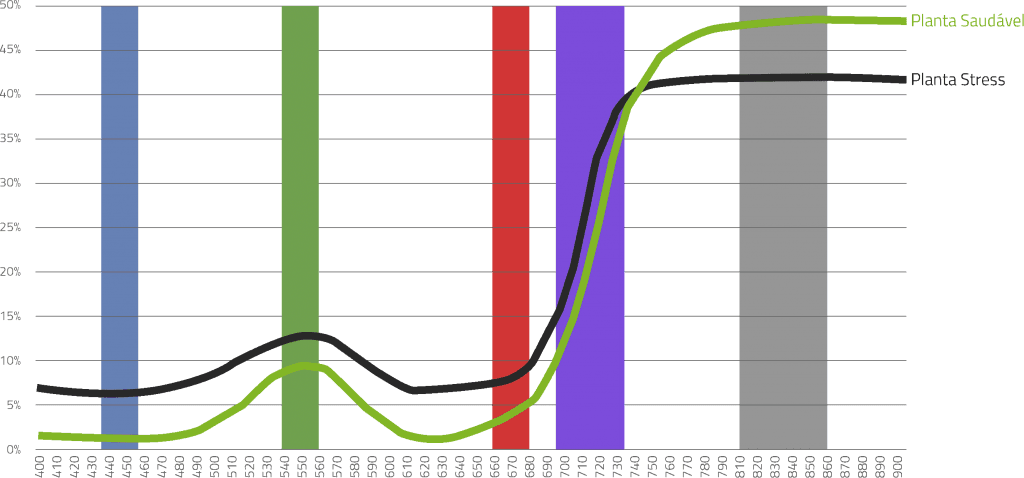
The XM5 uses standard spectral bands released to the market, operating in:
Blue: 435 to 455nm
Green: 540 to 560 nm
Red: 660 to 680 nm
RedEdge: 695 to 735nm
Nir: 810 to 860nm

XMC is the multispectral version developed specifically for the sugarcane crop, as it has spectral bands designed specifically for the response of sugarcane's spectral signature, making it possible:
- Greater assertiveness in sugarcane row restitution, as XFarming looks for the highest plant vigor at the top of the plant;
- Greater assertiveness in planting failure, defined as plant vigor failure;
- Better contrast between sugar cane and weeds such as castor bean, viola rope, mucuna, brachiaria, silk grass, etc.
As this is a solution dedicated to the sugarcane sector, the spectral bands that bring all the above benefits are not disclosed, as they are considered to be the technology's confidential data.