
The Ministry of Agriculture and Livestock (MAPA) recently announced the soybean sowing schedules for the 2023/2024 harvest in 21 states.
This initiative aims to combat the resistant form of Asian soybean rust, one of the most devastating diseases affecting this vital agricultural sector.

Why is the Sowing Calendar essential?
Adopting a sowing calendar is a vital phytosanitary strategy to complement the fallow period.
The main objective of this measure is to minimize the inoculum of the dreaded Asian soybean rust, recognized for its ability to cause substantial damage to crops.
Asian rust is one of the most serious diseases facing the soybean crop, and reducing its incidence is essential to ensure healthy production.
Measures of the National Program for the Control of Asian Soybean Rust (PNCFS).
The PNCFS aims to rationalize the application of fungicides and reduce the risk of resistance to the fungus Phakopsora pachyrhizi to the chemical substances used to control it.
This approach is crucial to avoiding resistance and maintaining effectiveness in the fight against Asian rust.
Reflections of last season and changes adopted
Compared to the calendars for the previous harvest, the changes for the 2023/2024 harvest were guided by the analysis of data from the Anti-Rust Consortium.
The previous harvest caused a significant increase in cases of Asian rust due to the rainfall at the time, according to Embrapa Soja.
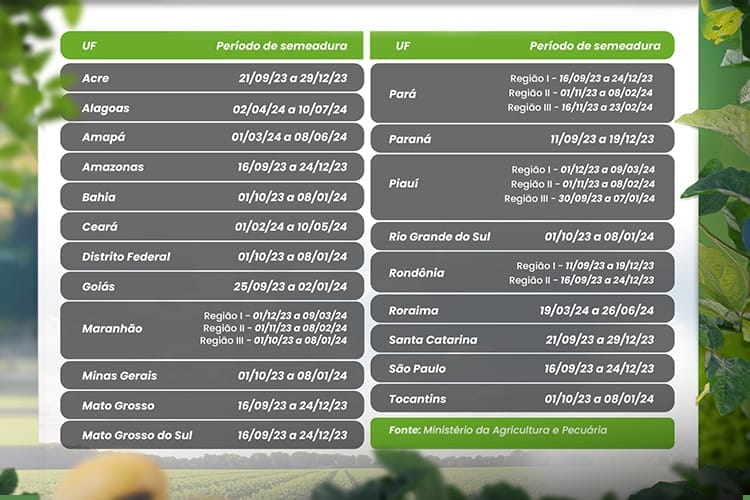
The delicate equation of soybean sowing time
As part of its Asian rust management tactics, the Secretariat of Agricultural Defense has set a period of up to 100 calendar days for sowing calendars in all soybean-producing states.
This restriction was recommended by Embrapa to avoid serious epidemics during a harvest.
Call for joint action
MAPA reinforces the importance of a collaborative effort between producers and state Plant Health Defense agencies in each unit of the Federation.
The revision of exceptional cultivation permits is crucial to contain the spread of Asian rust and protect soybean production.
Challenges of Asian rust
This disease has the potential to affect the soybean crop at any phenological stage.
In regions where epidemics have occurred, damage to production has ranged from 10% to 90%, demonstrating the urgency of preventative measures.
Conclusion: Sowing soybeans
The soybean sowing calendar for the 2023/2024 harvest established by the Ministry of Agriculture and Livestock is a vital tool in the fight against Asian rust.
Collaboration between all stakeholders is essential to ensure a healthy and productive harvest, protecting soybean production and strengthening the agricultural industry.
Don't take that risk, bet on the spraying drone as a tool to combat Asian rust.
Visit: xmobots.com.br